
The Creative Freedom Framework
A Simple Idea: Secure the Floor, Then Let People Build

Most economic debates argue about how much government we need.
But the real question might be different:
What if government had one primary job—secure the foundations of life—and then step back far enough for human creativity and freedom to flourish?
My solution:
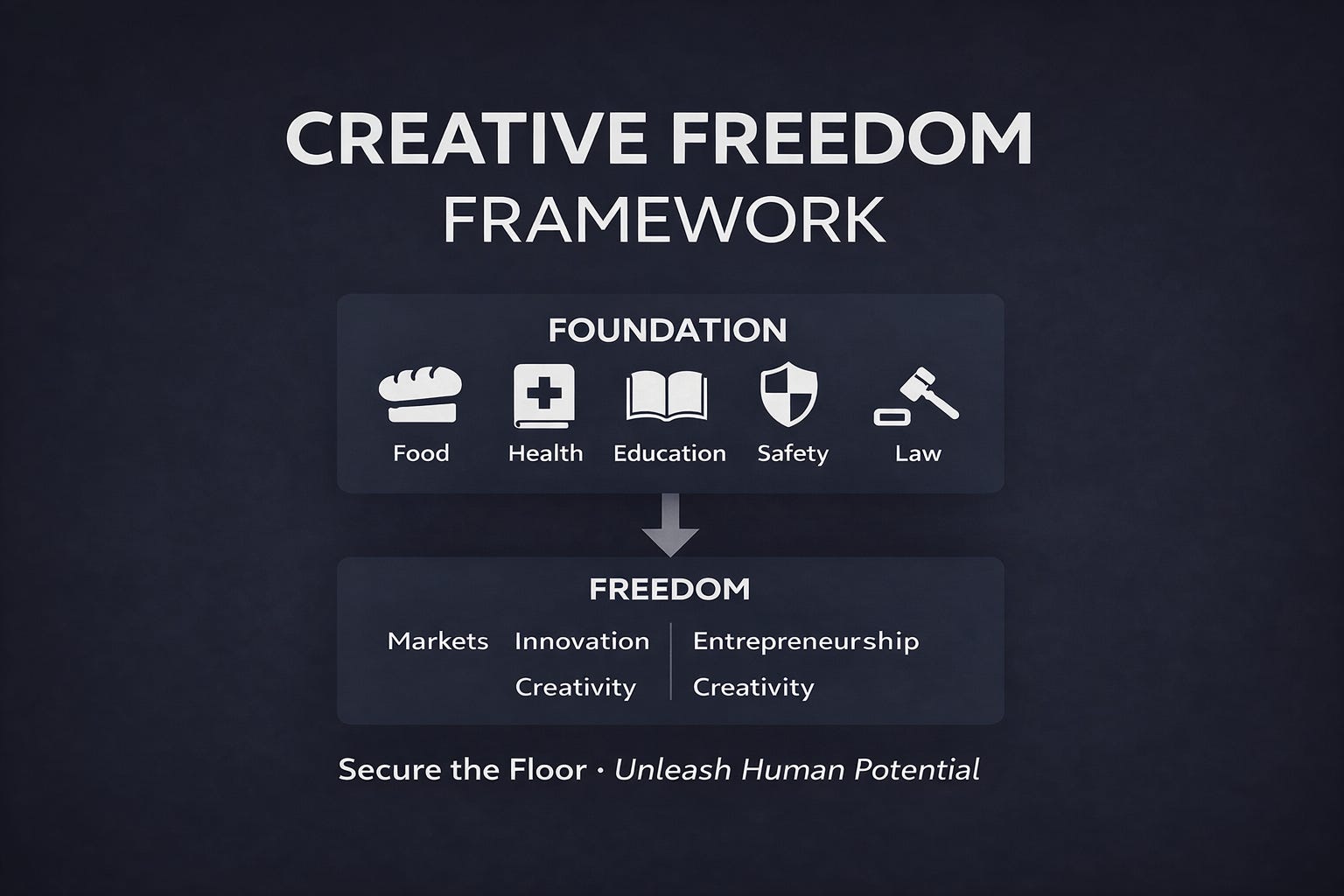
The Creative Freedom Framework
Part 1: Freedom Needs a Foundation
Modern economic debates often fall into a familiar trap.
One side argues for stronger government systems to protect people from instability and inequality. The other argues that freedom, markets, and entrepreneurship drive progress and prosperity.
Both perspectives contain truth.
But both often fail in the same place: power concentration.
When power concentrates—whether in governments, corporations, or institutions—systems stop serving people and begin serving themselves.
The Creative Freedom Framework is an attempt to address this problem directly.
Its premise is simple:
A society works best when it guarantees a stable human foundation, limits the concentration of power, and then allows maximum creative and economic freedom above that foundation.
The Problem: Freedom Without Stability Isn’t Real
In theory, many societies already offer freedom.
In practice, that freedom often exists only on paper.
When people face constant fear of losing food, healthcare, housing, or safety, their choices become constrained by survival.
Desperation distorts freedom.
People accept exploitative conditions, avoid risk, suppress creativity, and cling to stability rather than pursuing opportunity.
A healthy system must first ensure that freedom is practical, not theoretical.
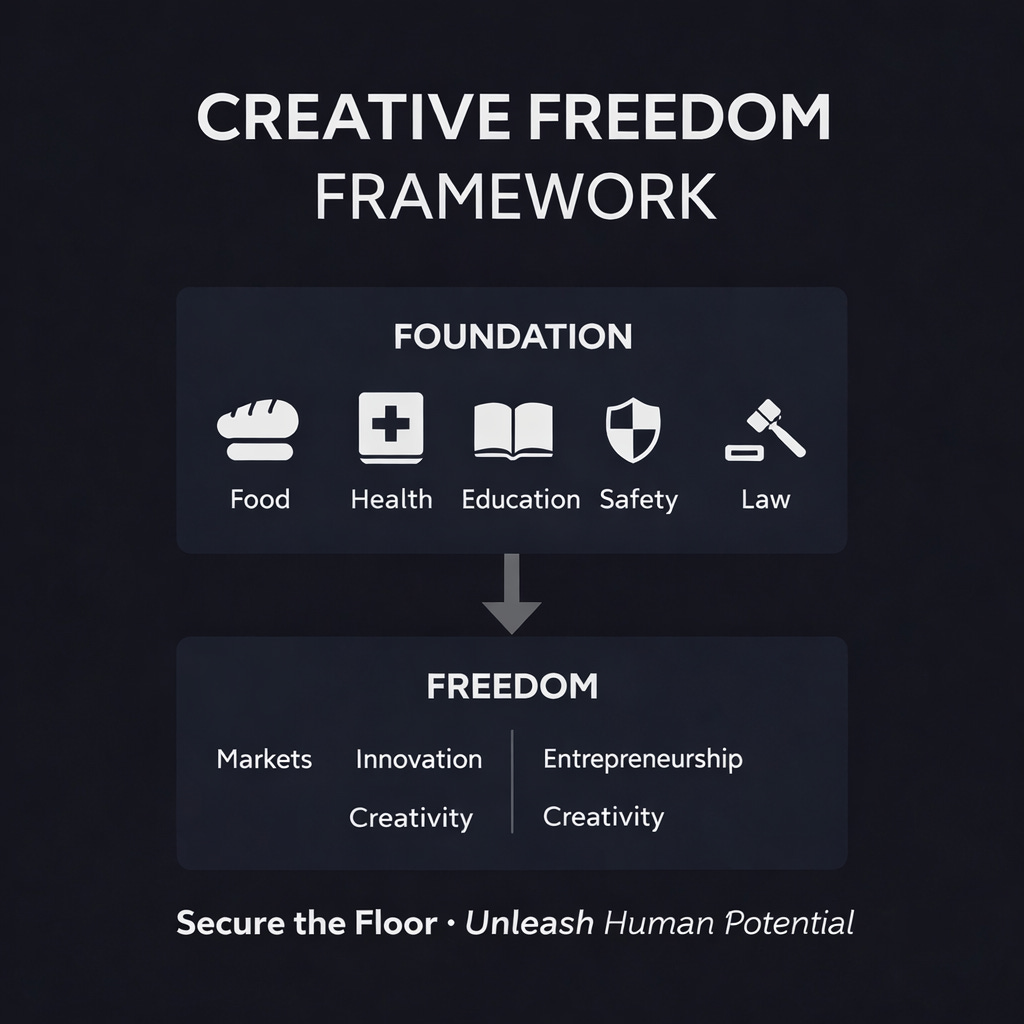
The Foundational Floor
The Creative Freedom Framework begins with a simple responsibility for government:
Guarantee the basic conditions required for human stability.
These include:
• Reliable food security
• Basic healthcare access
• Access to education
• Public safety and rule of law
• Equal legal protection
This foundation is not about forced equality or centralized control.
It is about preventing desperation from distorting freedom.
When the basic floor of society is stable, people can actually exercise choice.
Freedom Above the Floor
Once that foundation exists, the system shifts its posture.
Government steps back.
Markets, creativity, and voluntary exchange take the lead.
Above the foundational floor:
• Private ownership exists
• Entrepreneurship is encouraged
• Markets operate freely
• Innovation is rewarded
• Individuals choose their paths
The goal is not to manage outcomes.
The goal is to maximize human agency.
People should be free to build businesses, explore ideas, create art, pursue research, or take risks without the constant threat of survival collapse.
The Real Threat: Power Concentration
Every economic system eventually faces the same danger.
Power begins to concentrate.
Corporations consolidate.
Institutions capture regulators.
Political systems become insulated from the public.
Over time, systems designed to serve people become systems that serve power itself.
The Creative Freedom Framework treats this as the central structural threat.
Safeguards must be built directly into the system:
• Strong anti-monopoly enforcement
• Institutional transparency
• Clear limits on state authority
• Protections against regulatory capture
• Diffusion of political and economic power
Freedom requires more than opportunity.
It requires systems that prevent domination.
The Civic Immune System
Healthy societies need something like an immune system.
A structure that continuously detects and responds to power concentration before it becomes systemic.
This civic immune system includes:
• independent oversight institutions
• transparent public data on spending and influence
• clear antitrust triggers
• protections for investigative journalism and whistleblowers
The goal is not perfection.
The goal is constant correction.
No system can prevent every abuse of power.
But a resilient system can detect and repair damage before it spreads.
What Success Looks Like
The Creative Freedom Framework does not measure success purely by economic output.
Instead, the primary measure becomes:
the expansion of human capability and opportunity.
A healthy system should increase people’s ability to:
• create
• build
• experiment
• collaborate
• pursue meaningful work
Economic growth matters.
But growth should serve human development, not replace it.
The Philosophical Spine
At its core, the framework rests on a few simple principles.
• Human dignity comes first
• Freedom must be practical, not abstract
• Incentives matter
• Power must be constrained
• Systems should expand choice, not centralize control
These principles are not ideological.
They are structural.
The Hard Question
One challenge remains.
Even well-designed systems must operate in a world that is fragmented, wounded, and distrustful.
Many people have been harmed by existing systems.
Others benefit from them.
Some will inevitably attempt to exploit or damage any new framework.
So the real question becomes:
How do we build stable, free systems in a world where trust is fragile and people are imperfect?
That is the deeper problem the Creative Freedom Framework attempts to explore.
The question is not whether society should have systems.
The question is whether those systems expand freedom or concentrate power.
Where This Conversation Goes Next
This article introduces the core idea.
Future pieces will explore questions such as:
• How could this framework be implemented in real economies?
• What mechanisms actually prevent power concentration?
• How do we build systems that remain resilient against corruption?
• What role could technology play in maintaining transparency and accountability?
These are difficult questions.
But they are worth exploring.
This framework started from a Question Everything channel chat discussion which asked:
“What do you believe is the best existing economic system for a nation? Why?
Can capitalism pave the way for oligarchies?
Can socialism pave the way for communism?
Can communism pave the way for totalitarianism or fascism?
What ideas do you have for an economic system that is better than these existing systems? Why?
My answer, was:
“I may be outside the box, but I feel like we don’t have a “term” or existing framework for what is better. I think the only truly free way is a simple government body whose only goal is to bring the basic necessities to the people and allow them the freedom to use their creativity how they choose. The problem isn’t the systems, it’s the people who want power over others. Yeah I know I’m a “woke hippy.” Sue me.”
The responses to that statement were overwhelmingly positive, which surprised me.
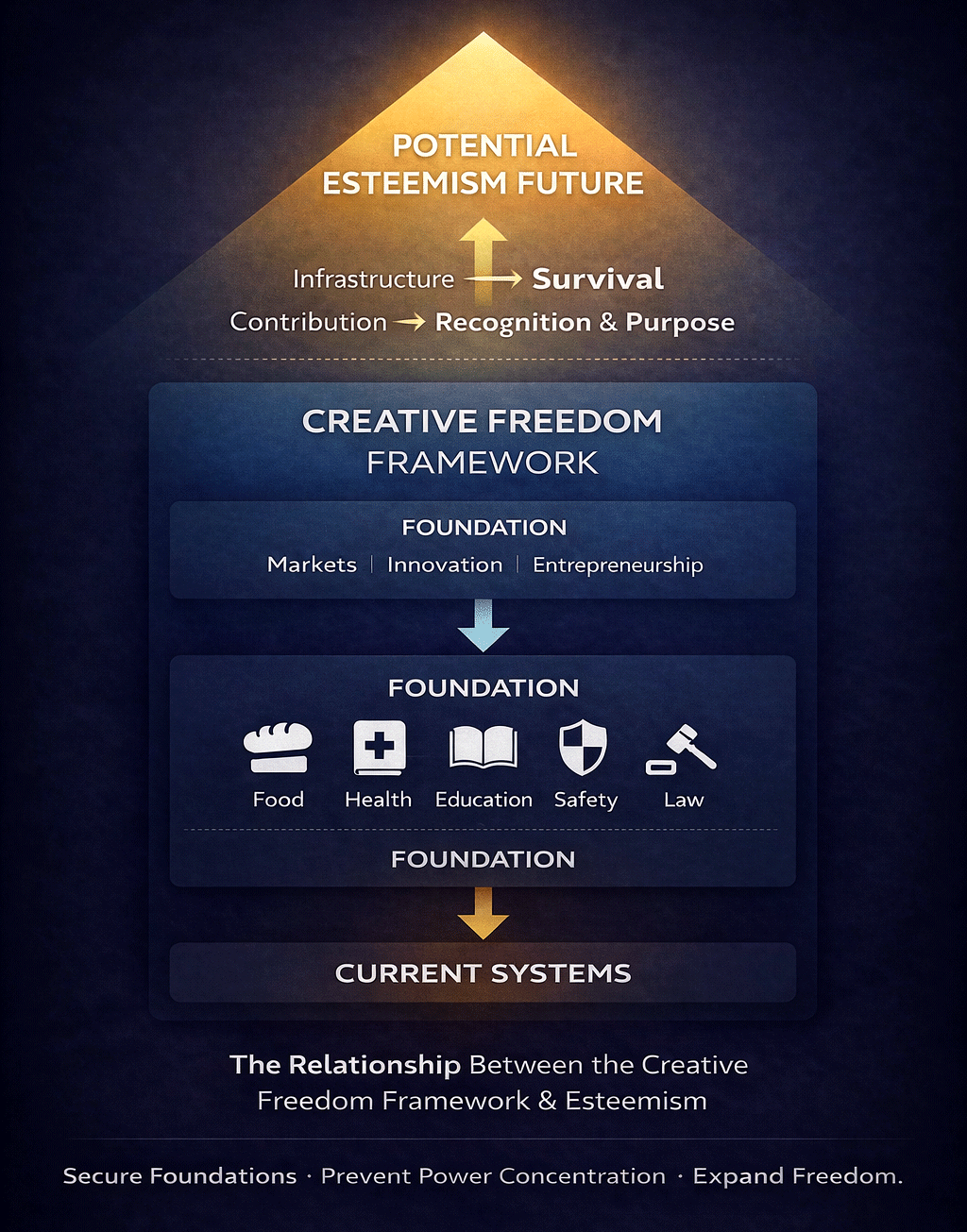
I was inspired to finish that thought out and into this framework after hooking up with Zul Arifin. I loved his concept of Esteemism, which I wrote about in my last article, A World Beyond Work - The Esteemism Framework.
This is my solution to achieve it.
Join the Discussion
The goal of this project is not to present a finished ideology.
It is to explore a structural question:
What kind of economic system maximizes both stability and human freedom?
I’m interested in hearing where this framework holds up—and where it breaks down.
Share your thoughts in the comments.
